
3 Tips for a Solid Summer
- Posted by Kathleen
- Categories College Admissions, Elementary School, ERB, High School, ISEE & SSAT, Middle School, SAT & ACT
- Date June 4, 2026
Every summer, families face a familiar tension: how to let students enjoy a well-deserved break from the classroom while ensuring they don’t lose the hard-earned academic progress they made over the past nine months. The phenomenon often referred to as the “summer slide” is well-documented, particularly in cumulative subjects like mathematics and language arts.
However, preventing this setback doesn’t require replicating a rigid school day at the kitchen table. In fact, an overly demanding summer schedule can often backfire, leading to academic burnout before the new school year even begins.
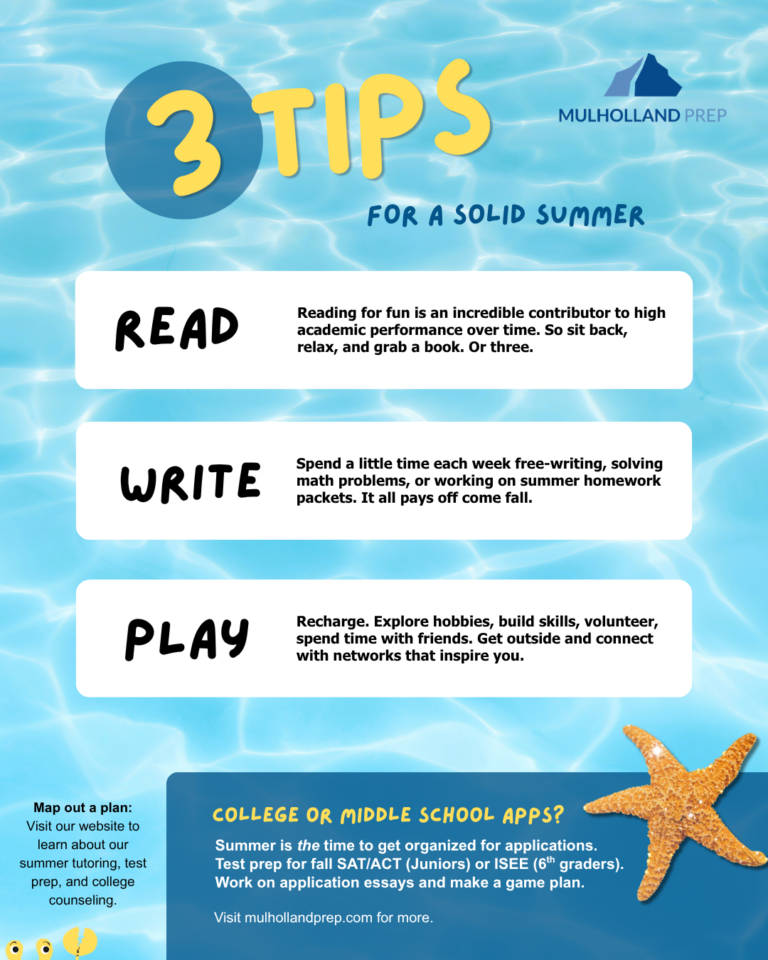
At Mulholland Prep, we advocate for a simplified, three-part approach to the summer break: Read, Write, and Play. Grounding the vacation months in these core pillars keeps the brain active while honoring a student’s need to rest and reset.
1. Read (For Pleasure)
Reading for fun is one of the single most effective indicators of long-term academic performance. Over the summer, the emphasis should shift away from forced reading lists or analytical essay prompts and toward complete autonomy.
When students are given the freedom to choose their own material—whether that means a science fiction novel, a biography, or a long-form journalistic piece—they internalize the habit of reading rather than treating it as a chore. Aiming for just 20 minutes a day maintains reading comprehension, expands passive vocabulary, and acts as a natural mental decompression strategy.
2. Write (And Practice Math)
Unlike reading comprehension, which tends to stay relatively stable, specialized mechanics like arithmetic, algebraic structures, and technical composition fade quickly when completely ignored. A student who finishes the school year understanding how to divide complex fractions or structure a thesis sentence can easily blank out on those exact execution steps by September.
A manageable countermeasure is consistency over volume. Dedicating a brief pocket of time each week, perhaps 20 to 30 minutes total, to free-writing, solving fundamental math problems, or systematically working through school-assigned summer homework packets keeps the operational gears turning. It is not about mastering entire new domains; it is about cognitive maintenance.
3. Play (With Intention)
Downtime is often dismissed as empty space, but cognitive development heavily relies on periods of unstructured focus and play. We view constructive play as an essential vehicle for growth, self-discovery, and mental recovery.
Summer provides an unstructured canvas that the school year simply cannot accommodate. Encourage students to explore personal hobbies, volunteer for local organizations, try creative projects, and spend quality time with friends. These activities don’t just reduce academic fatigue; they teach self-direction, build practical real-world skills, and allow students to establish genuine peer and mentor networks that inspire them outside the margins of a traditional classroom.
Some EXCEPTIONS:
While the Read, Write, Play framework provides an ideal equilibrium for everyday academic maintenance, some age groups require a slightly more strategic approach during these months.
- Standardized Test Prep: For rising juniors looking ahead to the fall SAT/ACT, or rising 6th graders preparing for the ISEE, the summer months offer a very important window. Studying during this break allows students to establish consistent testing strategies without competing for time against heavy nightly homework loads and demanding extracurricular activities.
- Admissions Applications: For rising seniors, the summer between junior and senior year is incredibly valuable. Utilizing this window to organize deadlines, finalize college lists, and draft application essays changes the entire landscape of the autumn semester, preventing a chaotic bottleneck once senior classes begin.
Designing Your Family’s Summer Framework Every student’s baseline is different. Finding a pace that preserves mental health while keeping foundational skills sharp requires an intentional plan that fits cleanly into your family’s vacation and travel schedules.
Whether you need a structured review of core subjects, dedicated test preparation, or comprehensive college admissions counseling, Mulholland Prep provides targeted, low-stress, individualized support to get your student exactly where they need to be.

About Our Tutors
At Mulholland Prep, our skilled tutors are passionate about helping students excel in every subject. Whether it’s mastering math concepts, improving reading comprehension, or boosting study skills, our team provides personalized support designed to meet each student’s unique needs. With a focus on building confidence and long-lasting academic success, our tutors are here to guide you every step of the way.
Ready to take your learning to the next level? Enroll today!
Kathleen is a manager at Mulholland Prep. Drawing on years of experience as an educator, she writes to provide accessible resources for students, parents, and other teachers.
You may also like

3 Academic Tips for a Successful School Year (and How Parents Can Help)